Executive Summary
In Q2 2025, salary transparency in U.S. job postings crossed 50% for the first time, a milestone that had been building for years as state-level pay transparency legislation gathered pace. What followed was rapid normalization: by January 2026, the national disclosure rate reached 55.3%, an all-time high. Since then, the rate has plateaued, holding at 54.2% through Q1 2026, suggesting the market may be settling into a new normal rather than continuing its sharp upward climb. For employers, this trajectory is not just a data point; it reflects a permanent shift in candidate behavior, a tightening compliance landscape, and a widening competitive gap between employers who disclose and those who do not.
How We Got Here: A Quarterly Story
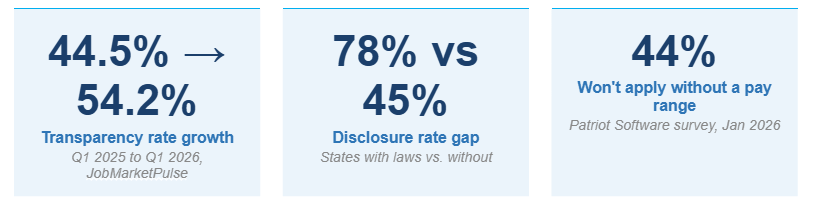
Salary transparency did not cross 50% overnight. The JobMarketPulse Q1 2025 report shows the national disclosure rate opened the year at 44.5%, meaning just under half of all active job postings on employer career sites included compensation data. That was already a significant shift from where the market stood two years prior, driven largely by Colorado, Washington, California, New York, and a handful of other early-adopter states.

The inflection came in Q2 2025. New state laws in Illinois, Minnesota, New Jersey, Vermont, and Massachusetts either took effect or expanded their coverage, pushing the national rate above 50% for the first time. The 2025 annual report shows the rate continued to climb through Q3 and Q4, closing the year at 53.1%, meaning the majority of U.S. job postings now include salary data as a matter of course.
The Q1 2026 report shows the trend peaked in January 2026 at 55.3% before pulling back slightly to 54.2% by March, the first sustained dip since the trend began. The gap between regulated and unregulated states remained stark: 78% disclosure in states with transparency laws versus 45% in states without. Massachusetts, New Jersey, and Vermont recorded the three largest single-year jumps in disclosure rates on record.
The Legislative Wave Is Not Slowing
As of 2026, 16 states plus Washington D.C., have enacted statewide wage transparency laws, with the pipeline continuing to expand. A GovDocs 2026 roundup estimates that 50% of the U.S. population now lives in a jurisdiction where some form of pay transparency is legally required.
-
Massachusetts expanded its law in October 2025 to cover employers with 25+ employees, driving a 28.1-point YoY jump in transparency rates, the largest single-year increase on record (JobMarketPulse).
-
New Jersey's Pay Transparency Act took effect in June 2025, requiring salary ranges and benefits descriptions in all postings, contributing to a 27.7-point YoY jump.
-
Virginia joined the regulated states effective July 1, 2026, per GovDocs.
-
Delaware signed legislation in September 2025, effective September 2027.
-
Alaska, Indiana, Iowa, Kentucky, Maine, Missouri, and Montana all have draft bills under active review in 2026, per DAVRON.
|
NOTE
|
Massachusetts data point needed: Pending data from Anastasiia, to be updated with JobMarketPulse figures showing MA disclosure rate before the October 2025 law vs. Q1 2026 rate (illustrating the before/after impact at state level).
|
A key compliance complexity flagged by Jackson Lewis: if a position can be performed from a state with transparency laws, most jurisdictions consider the posting covered regardless of where the employer is headquartered. For employers with any remote hiring, the most stringent applicable state law should be treated as the operational standard.
Why It Matters Beyond Compliance
Compliance is the floor, not the ceiling. The more immediate pressure on employers is competitive: candidates are now using salary data as a first-pass filter before engaging with a posting at all.
The Application Volume Effect
A January 2026 survey by Patriot Software of 1,000 U.S. adults who applied for jobs in the past year found that 44% say they are unlikely to apply for a job that does not list a pay range, with 45% describing non-disclosure as disrespectful. Among Gen Z candidates, 42% say the single transparency practice most likely to increase their application intent is a clear explanation of how pay is set, not just a number.
Separately, a 2026 GovDocs roundup cites research showing that 82% of U.S. workers are more likely to apply for a job when a pay range is listed. The directional consistency across research is hard to ignore: listing salary materially expands the top of the hiring funnel. In a market where the JobMarketPulse Q1 2026 report shows job postings declined 2.0% YoY, losing a significant share of candidate consideration when the salary field is missing is avoidable.
An NBER working paper (2025) also found that employers who had not previously disclosed salary saw wages at new hires rise 1.3–3.6% following transparency mandates, driven by heightened labour market competition. Employers who disclose proactively shape that competition on their own terms rather than reacting to it.
The Internal Equity Pressure
Publishing ranges externally forces internal discipline. Employees routinely compare posted ranges against their own compensation, and organizations without formal pay bands face compounding exposure: regulatory, reputational, and retention-related. Cornell University research published in HBR (February 2026) adds a nuance: salary ranges that are too wide can disadvantage candidates, particularly women, who prefer narrower ranges and negotiate less aggressively as a result. The implication for employers is that publishing a range is only the first step; the quality and context of the range matter too.
The Talent Risk of Staying Silent
The JobMarketPulse Q1 2026 data shows diverging performance across categories. Engineering postings grew 8.0% YoY, while Healthcare declined 4.9% YoY. Trades & Infrastructure grew 2.5% even as the broader market softened. In competitive hiring categories, salary visibility can be the deciding factor in whether a qualified candidate clicks Apply or moves on to a listing that reflects their worth upfront.
Salary Transparency and Google for Jobs
There is an angle to salary transparency that often goes overlooked: its impact on search visibility. For employers who rely on their career site as a primary hiring channel, salary data is not just a candidate expectation; it is a Google ranking signal.
Google's JobPosting structured data guidelines recommend salary as a key field in job posting schema markup. Industry practitioners note that postings with salary included in structured data consistently outperform those without, with some reporting meaningfully higher click-through rates in Google for Jobs results. As one SEO guide puts it, if you neglect salary and your competitors include it, they will rank higher in Google for Jobs listings.
The implication for employers is that salary transparency is simultaneously a compliance requirement, a candidate-acquisition lever, and a search-optimization decision. Employers who treat their career site as a channel, not just a job list, need to understand how salary structured data affects their visibility in Google for Jobs, particularly as organic search continues to be a significant source of direct candidate traffic.
The JobMarketPulse Q1 2026 report tracks provider market share in Google for Jobs across the U.S. employers who are not monitoring their career site's indexing quality, schema compliance, and salary data completeness are likely leaving organic candidate traffic on the table, even as they invest in paid distribution channels.
What Employers Should Do Now
1. Audit Your Current Posting Footprint
Start by establishing a baseline. What percentage of your active postings include salary ranges? How does that compare against your sector average and the 54.2% national rate? The Q1 2026 report shows Healthcare, one of the highest-volume hiring categories, saw postings fall 4.9% YoY. Transparency is one of the lowest-cost levers to improve top-of-funnel performance in cost-sensitive, high-competition sectors.
2. Map Your Regulatory Exposure
Identify every state where you post jobs or where remote candidates could plausibly be located. That footprint, not your headquarters, determines which laws apply. With Virginia effective July 2026 and Delaware on the horizon for 2027, the regulated footprint will continue to expand. Jackson Lewis and Hunton Andrews Kurth both publish updated multi-state compliance guides that are worth reviewing before your next hiring cycle.
3. Build Pay Bands Before You're Forced To
The employers who struggled most with Massachusetts and New Jersey compliance were those who had never formalized salary ranges. Proactive band-setting, tied to job architecture and market benchmarks, makes posting easier, reduces legal risk, and creates the internal equity foundation needed to withstand scrutiny. GovDocs notes that penalties in Colorado, Washington, and New York range from thousands to tens of thousands of dollars per posting violation.
4. Fix Your Career Site Schema
If your career site does not include salary data in its JobPosting structured data markup, you are missing a Google for Jobs ranking signal and likely underperforming in organic candidate search. Validate your job posting schema using Google's Rich Results Test and ensure salary is populated correctly wherever it is listed in the job description. For roles in regulated states, the markup and the on-page content must match; Google flags and can penalize discrepancies.
5. Don't Pull Back With the Market
The first pullback in national transparency rates, from 55.3% in January to 54.2% by March 2026, coincides with a broader softening in job postings. Employers who quietly reduce disclosure as hiring slows hand a competitive advantage to those who hold the line. The Patriot Software research and NBER findings point in the same direction: transparency expands the candidate funnel. That advantage matters most when the overall pool of active candidates is contracting.
How JobMarketPulse Helps Employers
Understanding where you stand on salary transparency and where your competitors stand requires real-time data. That is precisely what Aspen Tech Labs' JobMarketPulse is built to provide.
JobMarketPulse tracks salary data directly from employer career sites, not job boards, not estimates, across more than 225,000 U.S. companies, updated daily. For direct employers navigating the transparency shift, that means having the intelligence to act, not just observe:
-
Understanding talent supply before you post — research candidate counts by job type and geography, map where the right candidates actually are, and identify supply and demand imbalances affecting your talent pool before committing recruiting budget.
-
Knowing your competitive position in real time — monitor competitor job postings, hiring momentum, and reductions as they happen, so you're never caught off guard when a competitor targets your existing staff.
-
Salary intelligence from live postings, not surveys — see what the market is actually paying by title and location, score your pay offer as a percentile, and know exactly when compensation is working for or against you in the candidate market.
-
"My Jobs" — your postings auto-benchmarked against the market — no manual filtering; your open roles are instantly compared against live market data, flagging high-competition positions before they underperform.
-
Get ahead of the BLS — track economic hiring signals and labor market shifts by role, location, and industry before government survey data is released, giving your team a genuine planning advantage.
The platform is tailored to your specific jobs, locations, and hiring competitors — not generic labor market data. To explore how JobMarketPulse can support your salary benchmarking, transparency compliance, and competitive hiring strategy, get in touch with the Aspen team.
Conclusion
Salary transparency crossed a tipping point in Q2 2025 and has not looked back. The journey from 44.5% at the start of 2025 to 55.3% in January 2026, as tracked across the full series of JobMarketPulse reports, reflects a structural shift in how the U.S. labor market communicates compensation. Candidates now expect it, legislators are mandating it, and Google rewards it.
For employers, the question is no longer whether to disclose; it is how to do it well. That means building pay bands that reflect the market, maintaining consistency across states and roles, ensuring career site schema is complete and compliant, and treating transparency as a permanent feature of the hiring process rather than a compliance checkbox. The employers best positioned for the rest of 2026 are those who made that shift before they were required to do so.